
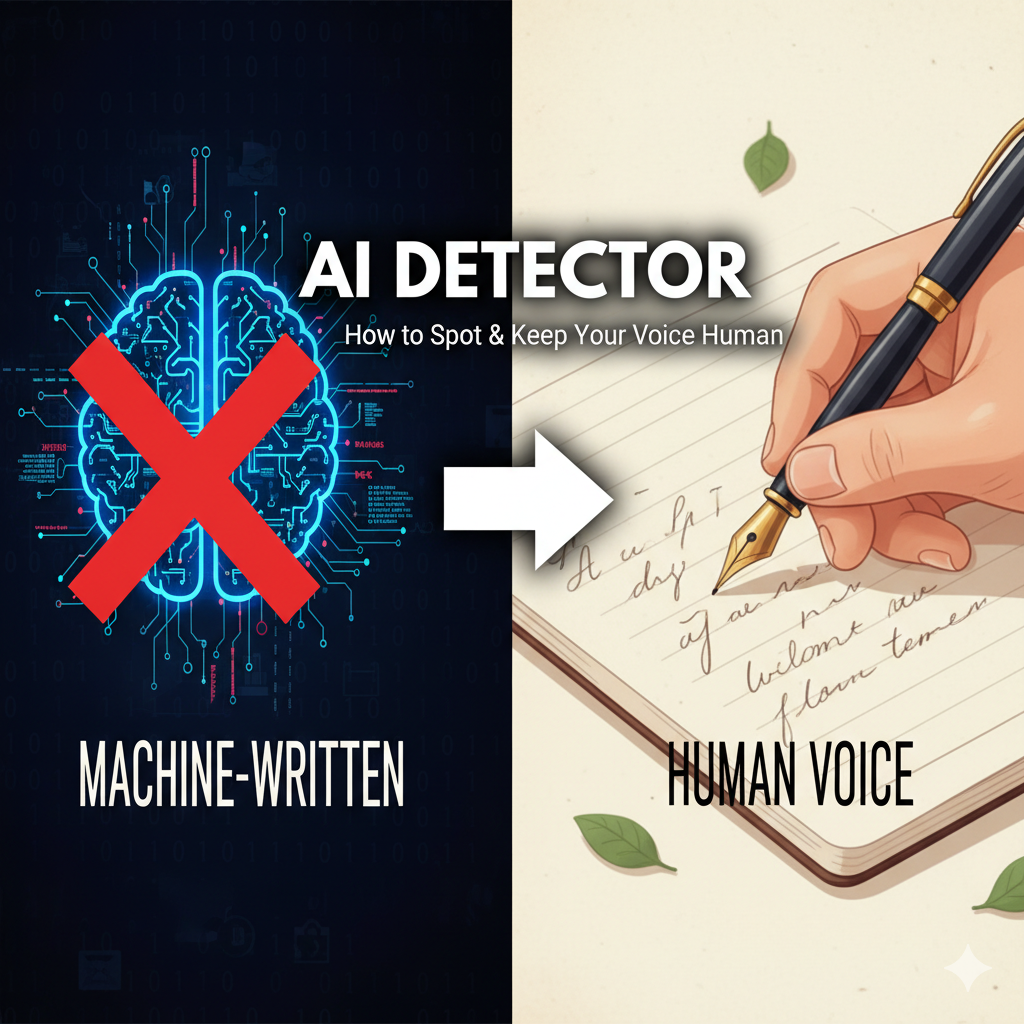
A blank page used to mean starting from scratch. Today, a few instructions can produce an entire article, email, assignment, or report almost instantly. Generative AI has changed the speed of writing, but it has also introduced a new question: How can you tell when text may have been produced with artificial intelligence?
An AI detector is designed to explore that question by examining the characteristics hidden inside written language. Rather than judging the topic itself, it studies patterns within the text and estimates whether those patterns resemble machine-generated writing.
Looking Beyond Perfect Grammar
Good grammar is no longer enough to judge how content was created.
AI systems can produce sentences that are clean, organized, and easy to understand. At the same time, some machine-generated passages can feel strangely uniform. The wording may be predictable, transitions may follow familiar formulas, and sentences may have remarkably similar construction.
An AI detector can analyze these characteristics to identify signals that deserve a closer look.
This makes detection different from ordinary proofreading. A spell checker asks, “Is this word correct?” An AI detector asks a much broader question: “What patterns can be observed in the way this passage was written?”
What Happens During an AI Detection Check?
When text is submitted for analysis, the system can examine multiple linguistic features. Depending on the technology behind the tool, these may include word predictability, sentence variation, structural repetition, and other statistical characteristics.
One useful concept is predictability. If the next word or phrase in a passage is extremely easy for a language model to anticipate, the writing may display characteristics commonly found in generated text.
Sentence variation can also matter. Natural writing tends to move between different sentence lengths and structures, while some generated passages maintain a highly consistent rhythm.
These signals are considered together rather than relying on one specific word or phrase.
Who Uses AI Detectors?
The demand for AI detectors has expanded alongside generative writing tools.
Educators may use detection technology when reviewing assignments that appear inconsistent with a student's previous work.
Publishers and editors can use it as an additional screening method for submitted material.
Businesses may review AI-assisted website copy to ensure it has been properly edited and reflects the company's own voice.
Writers can also use detection tools during their editing process, especially when they want to identify portions of a draft that sound overly standardized.
The technology can therefore serve several purposes, provided its results are interpreted carefully.
Detection Is Not the Same as Proof
One of the most important points about an AI detector is that its result should not automatically be treated as definitive evidence.
Language is complicated. A person can naturally write in a highly structured style, while AI-generated content can be heavily edited until it sounds much more personal. Short passages can also provide limited information for reliable analysis.
For this reason, detection results are more useful as signals for further examination than as final verdicts.
Making Content Sound More Genuine
If an analysis highlights a section as potentially machine-generated, the answer is not simply replacing a few words.
Better editing starts with substance. Add specific examples. Remove empty statements. Introduce information that genuinely belongs to the subject. Combine short and long sentences naturally. Replace generic explanations with clearer, more precise language.
Most importantly, make sure the writer's actual ideas remain visible throughout the piece.
These improvements make content stronger for readers—not merely different for a detection system.
The Changing Role of AI Detection
As generative AI becomes more sophisticated, the relationship between writing and detection will continue to change. Detection technology will need to adapt alongside increasingly capable language models.
An AI 검사기 can be useful in this environment because it provides another layer of analysis when the origin or character of text is uncertain. But technology should support editorial judgment, not replace it.
Ultimately, the strongest content is not content that simply passes a detector. It is content with a clear purpose, useful information, distinctive thinking, and a voice that gives readers a reason to keep reading.
That is where meaningful writing still has an advantage—even in an age of instant AI-generated text.