
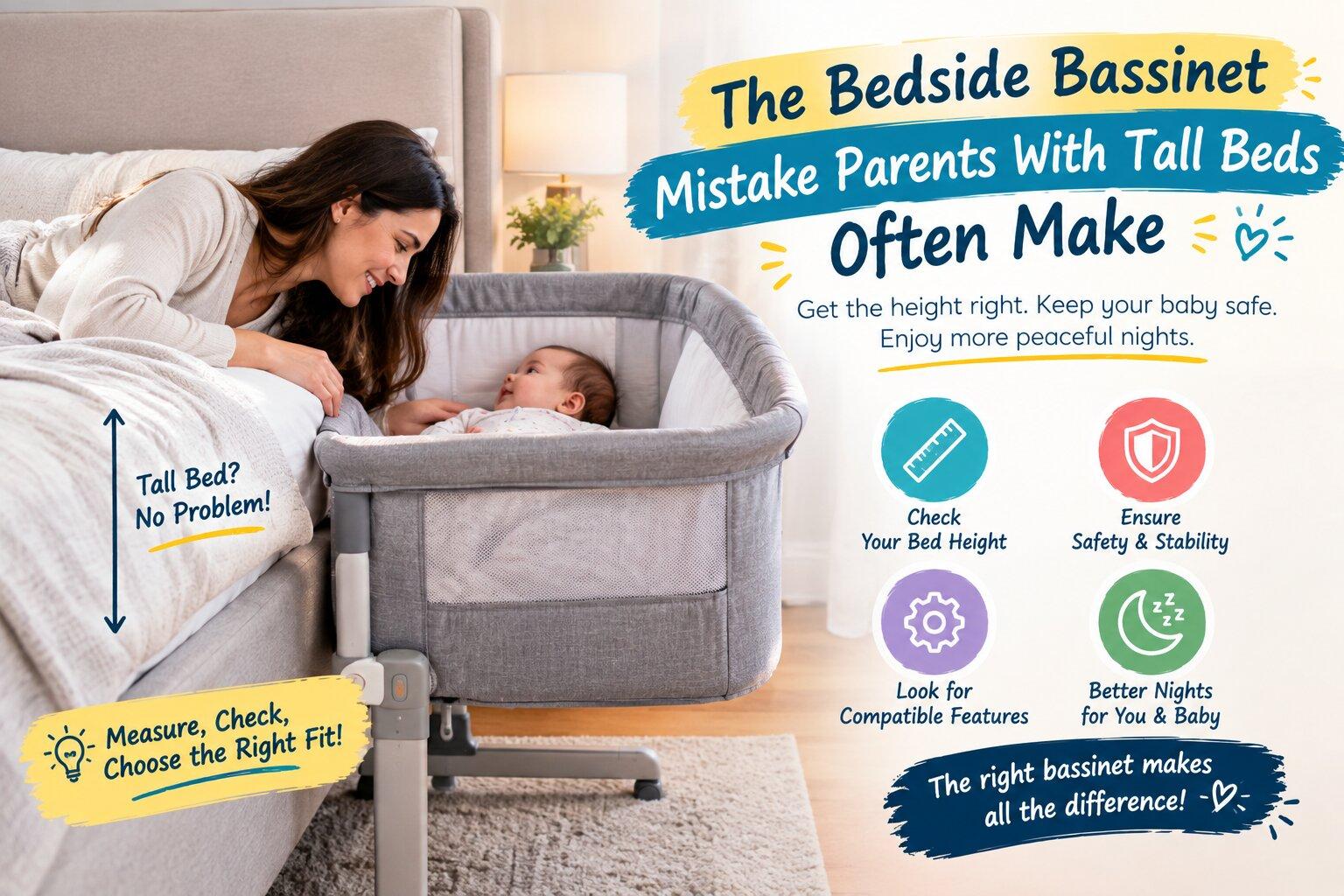
Preparing for a baby often means measuring everything twice. Parents check the nursery, the crib, the changing table, and even the space beside the bed. Yet there is one measurement that can easily get overlooked: the height of the adult mattress.
This matters more than many parents realize, especially when choosing a bedside bassinet for tall bed setups.
A bassinet may look perfect in a product photo, but that does not automatically mean it will work well beside your particular bed. A mattress that sits several inches higher than average can create compatibility, access, and safety concerns if the bassinet is not designed for that height.
The good news is that this mistake is easy to avoid. You do not need to become a baby-gear expert. You simply need to understand how bed height, bassinet height, attachment systems, and safe sleep practices work together.
Let's look at the common mistake parents make and how to choose and set up a bedside sleeping space more thoughtfully.
The Biggest Mistake: Looking at the Bassinet Before Measuring the Bed
It is tempting to start shopping by asking, "Which bassinet should I buy?"
For parents with a tall bed, a better first question is:
"How high is my mattress from the floor?"
That measurement gives you an important starting point.
Adult beds can vary significantly in height. A thick mattress placed on a tall frame can put the sleeping surface much higher than expected. Add a box spring, platform, or other foundation, and the final height can be quite different from what you see in a showroom or online photograph.
A bedside bassinet for tall bed use should therefore be evaluated based on the actual sleeping surface of your bed rather than simply its advertised appearance.
Before buying, measure from the floor to the top of the adult mattress. Do not measure only the bed frame or box spring.
It is also useful to measure the distance from the floor to the top of the bassinet's mattress in its intended configuration, but never assume that matching heights alone makes a setup safe.
Why Bed Height Matters So Much
A bedside sleeper is designed to keep a baby close to an adult bed while providing the baby with a separate sleep surface.
The Consumer Product Safety Commission (CPSC) defines a bedside sleeper as an infant sleep product secured to an adult bed. Its safety requirements address issues such as attachment, separation from the adult bed, structural integrity, and the height of the surrounding barrier.
That means the relationship between the two surfaces is important.
If your adult mattress is unusually high, you cannot simply assume that any bedside sleeper can be positioned beside it. The manufacturer's specified bed-height range, attachment instructions, and permitted configurations matter.
This is where many parents make the mistake: they treat "adjustable height" as meaning "compatible with every bed."
It does not.
What "Adjustable Height" Really Means
Many bassinets have multiple height settings. That sounds reassuring, but adjustment ranges are limited.
For example, a product might have several positions that work with beds within a particular range. If your mattress is outside that range, raising the bassinet as high as possible may still not create an appropriate setup.
More height adjustment does not automatically mean universal compatibility.
When researching a bedside bassinet for tall bed, look for the manufacturer's exact specifications. Check:
- Minimum adult-bed height
- Maximum adult-bed height
- How the measurement is taken
- Whether the measurement refers to the floor or mattress support
- Which bassinet modes permit bedside use
- Whether an attachment system is required
- Whether your bed frame is an approved configuration
The wording in the instruction manual matters more than a product photograph.
Don't Confuse a Tall Bed With a Tall Mattress
There is another small detail worth understanding.
Your bed's overall height and your mattress's height are not necessarily the same thing.
Imagine a bed with a low frame and a very thick mattress. It might feel tall when you sit on it, even though the frame itself is relatively low.
Now consider the opposite: a tall platform with a thinner mattress.
For a bedside sleeper, what matters is the measurement specified by the manufacturer. Follow that measurement rather than creating your own definition of "tall."
This is one reason reading the instruction manual before purchasing can save considerable frustration later.
The Second Mistake: Trying to Fix a Height Problem Yourself
Suppose you buy a bedside sleeper and discover that your mattress sits higher than the manufacturer's recommended range.
It may be tempting to improvise.
Some parents might consider placing something underneath the bassinet, adding a platform, using extra padding, modifying the legs, or finding another way to raise the sleeping surface.
This is exactly where creativity should stop.
Infant sleep products are safety products. Changing their structure or positioning outside the manufacturer's instructions can introduce risks that the original product was not designed or tested for.
The CPSC's requirements for bedside sleepers specifically address attachment to adult beds, maximum separation, product disengagement, and structural performance.
If a bedside bassinet for tall bed setup does not fit according to the manufacturer's instructions, the answer is not to build a taller setup yourself.
Instead, choose a product or configuration that is specifically approved for your bed.
The Gap Between the Bassinet and Bed Matters
Another important consideration is the space between the infant's sleep surface and the adult bed.
A bedside sleeper needs to remain securely attached according to its instructions. The CPSC specifically identifies separation between the bedside sleeper and adult bed as a safety consideration.
Current CPSC guidance for bedside sleepers includes warnings about keeping the product properly secured and checking for an excessive gap. It also warns against filling a gap with pillows, blankets, or other objects because these can create additional hazards.
This is especially important for tall-bed setups because parents may be more likely to notice a height mismatch and attempt to compensate for it.
If there is a gap or the attachment system does not work as intended, stop and reassess the setup.
Do not solve the problem with household items.
A Tall Bed Does Not Mean You Need a Complicated Solution
It is easy to become overwhelmed when you realize your bed is taller than expected.
Fortunately, the solution usually starts with a few simple steps.
Step 1: Measure the Bed
Measure from the floor to the top of the adult mattress.
Write the measurement down.
Step 2: Check the Bassinet Specifications
Look for the manufacturer's stated adult-bed height range and compatibility information.
Step 3: Check Your Bed Structure
Some products may have restrictions involving the mattress, frame, box spring, or other components.
Do not assume that because one bed works, yours will too.
Step 4: Read the Attachment Instructions
If the product is designed to attach to the adult bed, understand exactly how that attachment works.
Step 5: Follow the Intended Configuration
Use every required component and the exact setup described by the manufacturer.
Step 6: Recheck Before Baby Sleeps There
Once assembled, inspect the complete setup rather than relying only on the initial assembly.
This process sounds simple because it is. The goal is not to make baby sleep equipment complicated. The goal is to avoid making assumptions.
Don't Focus Only on Convenience
One reason bedside sleepers appeal to new parents is convenience.
Having the baby nearby can make nighttime routines feel more manageable. Parents may be able to see the baby without getting out of bed, and a nearby separate sleep surface can support room-sharing.
But convenience should never override safe sleep principles.
The American Academy of Pediatrics recommends room-sharing without bed-sharing and recommends placing babies on a firm, flat sleep surface intended for infant sleep.
The CPSC likewise recommends using sleep products intended for infants that meet applicable federal requirements and keeping the sleep space free of items such as pillows and loose blankets.
So when choosing a bedside bassinet for tall bed, think about both accessibility and the complete sleep environment.
What Should Be Inside the Bassinet?
For routine infant sleep, simplicity is your friend.
The CPSC's safe-sleep guidance emphasizes "Bare is Best," meaning the sleep space should contain the baby and a fitted sheet rather than pillows, blankets, bumpers, or other soft items.
That means you generally do not need to fill the bassinet with:
- Pillows
- Loose blankets
- Stuffed animals
- Sleep positioners
- Decorative cushions
- Aftermarket padding
A simple sleep space is easier to check and maintain.
It also avoids turning the bassinet into a storage area during those hectic first weeks.
The Third Mistake: Buying Accessories Before Checking Compatibility
Parents often think about accessories after choosing a bassinet.
Mattress covers, organizers, storage pockets, sheets, and other extras can all seem useful. However, accessories should never interfere with the manufacturer's intended sleep surface or attachment system.
CPSC requirements address accessories and missing attachment components for bedside sleepers.
Before adding anything, check whether the manufacturer specifically permits it.
An accessory that looks harmless may change how a product folds, attaches, fits against the adult bed, or supports the mattress.
When it comes to infant sleep, "it fits" and "it is approved for use" are two different things.
Check the Mattress, Too
Parents sometimes spend so much time comparing bassinet frames that they forget about the mattress.
A bassinet mattress should be the one specified or approved for that particular product. Avoid replacing it with a thicker, softer, or differently sized mattress simply because it feels more comfortable.
CPSC bassinet standards include requirements related to mattress performance, stability, flatness, sleeping pads, and other structural features.
That is another reason a bedside bassinet for tall bed should be evaluated as a complete system rather than a collection of separate parts.
What If Your Bed Is Extremely Tall?
If your bed is significantly taller than the available adjustment range, don't assume that every bedside sleeper is unsuitable.
Instead, look for a model whose specifications specifically accommodate your measurement.
You may also decide that a freestanding bassinet positioned near the bed better suits your room. The important point is that you should use the product according to its intended design.
There is no prize for making a particular bassinet work with a difficult setup.
The safest setup is the one that follows the manufacturer's instructions and applicable safety requirements.
Recheck the Setup as Your Baby Grows
Another overlooked point is that infant sleep arrangements are not permanent.
A product may be appropriate only for a particular developmental stage. CPSC guidance notes that bedside sleepers are intended for young infants and that products have limitations related to developmental milestones and age.
Always follow the specific manufacturer's limits.
Do not continue using a bedside sleeper simply because the baby still fits physically.
Development matters.
Once a baby reaches the product's stated limit, or reaches the developmental milestone identified in the instructions, it is time to transition to an appropriate sleep product.
A Quick Checklist for Parents With Tall Beds
Before using a bedside bassinet for tall bed arrangements, run through this checklist:
Measure
Know the exact height from the floor to the top of your adult mattress.
Read
Check the manufacturer's height range and bed compatibility instructions.
Inspect
Make sure all required parts are present and correctly assembled.
Attach
If bedside mode requires an attachment system, use it exactly as instructed.
Check the Gap
Make sure the product sits correctly against the adult bed according to the manufacturer's requirements.
Keep It Bare
Use an appropriate fitted sheet and keep loose items out of the sleep space.
Don't Modify
Never improvise with blocks, cushions, extra mattresses, or homemade extensions to solve a height problem.
Check Recalls
Before using an infant sleep product, check current recall information from the relevant safety authority.
Watch Development
Stop using the product when your baby's age, size, or developmental stage reaches the manufacturer's limit.
Why Measuring First Makes Everything Easier
The biggest lesson here is surprisingly simple: buying a bedside bassinet should start with a tape measure, not a shopping cart.
A tall adult bed changes the compatibility question.
Instead of asking whether a particular bassinet looks convenient, ask whether it is designed for your specific bed height and configuration.
That one change in approach can help you avoid unnecessary returns, awkward setups, and potentially unsafe improvisations.
It also makes the shopping process easier because you immediately have a practical requirement to compare against product specifications.
Frequently Asked Questions
Can I use any bassinet beside a tall bed?
Not necessarily. A freestanding bassinet and a bedside sleeper are different product types. If you want the product to attach to or function alongside the adult bed in bedside-sleeper mode, follow the manufacturer's stated compatibility requirements.
How do I measure my bed for a bedside bassinet?
Measure from the floor to the top surface of your adult mattress. Then compare that measurement with the manufacturer's specified bed-height range and measurement method.
What if my bed is higher than the bassinet's maximum setting?
Do not raise the bassinet using homemade supports or other objects. Look for a product or configuration specifically approved for your bed height.
Can I put a thicker mattress in the bassinet?
Avoid making mattress substitutions unless the manufacturer specifically approves that mattress. Infant sleep products are designed and tested around particular sleep surfaces.
Can I fill the gap between the bassinet and bed with a blanket?
No. CPSC guidance specifically warns against filling a gap with pillows, blankets, or other items.
Is room-sharing the same as bed-sharing?
No. Room-sharing means the baby sleeps in the same room while using a separate sleep surface. The AAP recommends room-sharing without bed-sharing.
When should I stop using a bedside sleeper?
Follow the exact age, weight, developmental, and usage limits provided by the manufacturer. Developmental milestones can matter just as much as age.
Final Thoughts
A tall bed can make choosing a bedside sleeper slightly more complicated, but it does not have to make the process stressful.
The most common mistake is assuming that an adjustable bassinet automatically works with every bed. In reality, height ranges, attachment systems, bed construction, mattress specifications, and safe sleep requirements all matter.
When searching for a bedside bassinet for tall bed, start by measuring your bed. Then compare that measurement with the manufacturer's specifications. Follow the assembly instructions carefully, avoid homemade modifications, keep the baby's sleep space clear, and pay attention to the product's developmental limits.
Most importantly, remember that convenience is only one part of the decision. A good nighttime setup should give parents easy access to their baby while maintaining a separate, appropriate sleep environment.
A few minutes with a tape measure and the instruction manual can make a surprisingly big difference.