
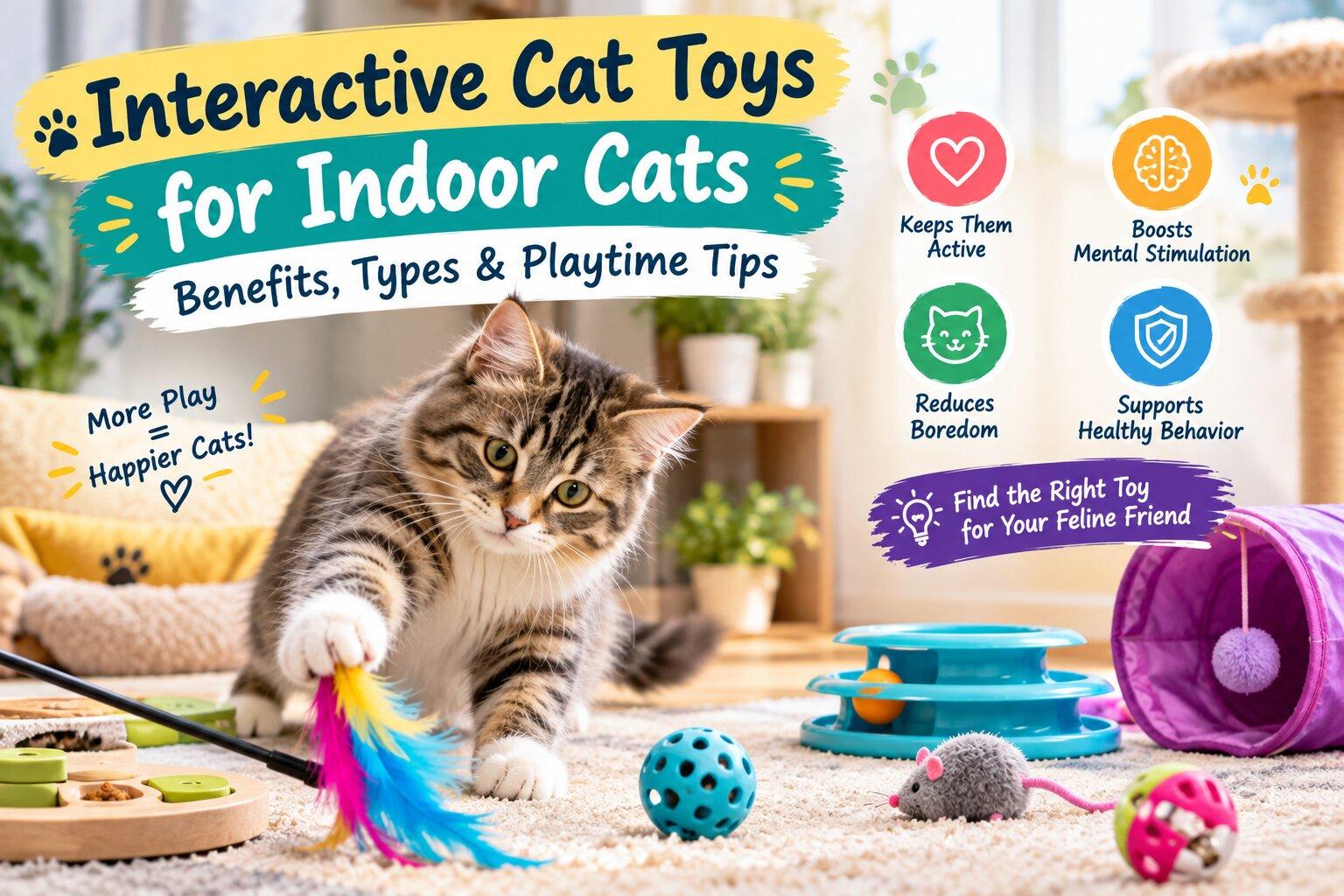
Indoor cats may have a comfortable life, but comfort does not always mean enough stimulation. A cat can have food, water, a cozy bed, and a sunny window and still spend long stretches of the day feeling bored.
That is where play becomes important.
Cats are naturally curious animals. They like to stalk, chase, pounce, bat, explore, and investigate anything that catches their attention. Outside, many of these behaviors happen naturally as cats explore their surroundings. Indoor cats, however, often have fewer opportunities to express them.
This is one reason Interactive Cat Toys for Indoor Cats have become such a useful part of everyday enrichment. Rather than simply giving a cat an object to bat around, interactive toys encourage movement, curiosity, problem-solving, or interaction with people.
The good news is that play does not need to be complicated. A few short, engaging play sessions can add variety to your cat's day and create more opportunities for exercise and mental stimulation.
Let's explore the benefits, different types of interactive toys, and simple ways to make playtime more enjoyable.
What Are Interactive Cat Toys?
Interactive cat toys are toys designed to encourage a cat to actively participate rather than simply lie beside the toy.
Some require your involvement. Others respond to your cat's movements. Some encourage chasing, while others involve food puzzles or problem-solving.
Common examples include:
- Wand toys
- Feather teasers
- Treat puzzles
- Motion-activated toys
- Rolling balls
- Interactive tunnels
- Electronic chase toys
- Food-dispensing toys
- Ball tracks
- Toys with unpredictable movement
The important part is the interaction.
A basic toy mouse may become interesting for a few minutes. An interactive toy can encourage your cat to make decisions, move around, chase something, or work toward a reward.
Not every toy needs electronics or batteries, either. A simple wand toy controlled by a person can provide highly engaging play.
Why Indoor Cats Need More Than a Food Bowl and Bed
Indoor living can provide safety and comfort, but it can also create a predictable environment.
Your cat knows where the food appears.
The water bowl stays in the same place.
The sleeping spot does not move.
The same rooms are available every day.
That predictability is not necessarily bad. Cats often appreciate familiar routines. However, they also need opportunities to explore and engage their natural behaviors.
The American Association of Feline Practitioners describes environmental enrichment as an important part of feline care and encourages opportunities for cats to engage in natural behaviors such as hunting, playing, scratching, climbing, and exploring.
This is where Interactive Cat Toys for Indoor Cats can fit naturally into a cat-friendly home.
They can introduce small challenges and changes without requiring you to completely redesign the living space.
Benefit #1: Interactive Toys Encourage Physical Activity
Indoor cats can become less active when their environment provides few reasons to move.
Play gives them a reason.
A rolling ball can encourage a cat to run across the room. A wand toy can make them jump or stretch. A tunnel can encourage them to move between hiding and chasing.
The amount of activity will vary from one cat to another.
A young, energetic cat may sprint around the room after a toy. An older cat may prefer slower movements and shorter sessions.
The goal is not to turn every play session into intense exercise.
Instead, think of play as a simple way to encourage movement throughout the day.
Benefit #2: Play Supports Natural Hunting Behaviors
One of the most interesting things about cats is how much their play resembles hunting.
Watch a cat playing with a feather toy and you may notice familiar behaviors:
Look.
Stalk.
Chase.
Pounce.
Grab.
These behaviors aren't accidental.
Domestic cats still retain many instincts associated with their wild ancestors. Interactive play can give indoor cats an appropriate outlet for some of those behaviors.
That is why toys that move unpredictably can often attract more attention than objects that simply sit on the floor.
A toy that slowly moves behind a chair may be more interesting than one placed directly in front of your cat.
Benefit #3: Interactive Play Provides Mental Stimulation
Physical activity is only part of the story.
Cats also need things to think about.
Puzzle toys and food-dispensing toys can encourage cats to figure out how to access a small reward. Motion-based toys can encourage observation and timing. Even a wand toy can require a cat to judge distance and movement.
This type of engagement can make the environment more interesting.
For indoor cats that spend many hours alone, adding small challenges can break up an otherwise predictable day.
This is one of the strongest reasons to include different types of Interactive Cat Toys for Indoor Cats instead of relying on one toy all the time.
Benefit #4: They Can Reduce Everyday Boredom
Boredom does not always look dramatic.
Sometimes a bored cat simply sleeps more because there is nothing interesting happening.
Other cats may look for their own entertainment by knocking objects from shelves, scratching furniture, opening cabinets, or getting into places they normally ignore.
Play cannot solve every behavior problem, but appropriate enrichment can give cats healthier ways to stay occupied.
Rotating toys can also help.
You do not need to leave every toy on the floor all day. Put some away and bring them back later.
A toy that disappeared for several days can feel more interesting when it returns.
Benefit #5: Play Can Strengthen Your Bond With Your Cat
Not every interactive toy needs batteries.
Some of the best play happens between a cat and their owner.
A wand toy, for example, gives you direct control over movement. You can make the toy crawl, hide, pause, and suddenly move away.
Your cat gets stimulation, and you get a chance to interact with them.
This can turn playtime into a shared routine rather than another task on your daily list.
Even a few minutes of focused attention can make a difference in how connected you feel with your pet.
Types of Interactive Cat Toys for Indoor Cats
There are many options available, but you do not need to buy everything.
Start by understanding the major categories.
1. Wand and Teaser Toys
Wand toys usually have a handle connected to a string, ribbon, feather, or another attachment.
They are popular because you control the movement.
You can make the toy:
- Crawl across the floor
- Hide behind furniture
- Move around corners
- Pause unexpectedly
- Change direction
- Move slowly before speeding away
This allows you to imitate some of the unpredictable movement associated with prey.
Always supervise toys with strings, ribbons, or similar parts. They should not be left with a cat unattended if the cat could chew, swallow, or become tangled in them.
2. Treat and Food Puzzles
Food puzzles combine play with feeding.
Instead of receiving every piece of food from a bowl, a cat may need to interact with the puzzle to access some of it.
These toys can provide mental stimulation while making meals more engaging.
However, introduce puzzles gradually.
If the challenge is too difficult, your cat may simply walk away.
Start with an easy design and increase the difficulty only when your cat understands how it works.
3. Motion-Activated Toys
Motion-activated toys respond when a cat approaches or touches them.
Some move, vibrate, make sounds, or activate lights.
These toys can be interesting because the cat does not know exactly when the movement will happen.
Still, some cats love motion while others find unfamiliar sounds annoying.
Pay attention to your cat's reaction rather than assuming every automatic toy will be exciting.
4. Interactive Balls
Rolling balls encourage cats to chase, bat, and follow movement.
Some move unpredictably, while others contain bells or textured surfaces.
Balls can be particularly useful for cats that enjoy independent play.
Choose a size that your cat cannot swallow and inspect the toy regularly for loose parts or damage.
5. Tunnels and Hide-and-Chase Toys
Tunnels give cats a place to hide while also creating opportunities for chasing.
You can move a toy near the entrance, allow your cat to hide, and then slowly move it away.
Some cats will happily run through the tunnel. Others may simply use it as a quiet hiding place.
Both uses are perfectly reasonable.
Cats often appreciate having places where they can retreat and observe their surroundings.
6. Puzzle and Problem-Solving Toys
Puzzle toys ask your cat to work out how something operates.
A compartment may hide a treat. A sliding section may need to move. A small opening may require your cat to use a paw.
These toys are especially useful when you want to introduce mental challenges into your cat's routine.
Start simple.
The objective is to create an interesting challenge, not frustration.
How to Choose the Right Interactive Toy
The best toy depends on the individual cat.
Consider your cat's age, personality, activity level, and preferences.
For energetic cats
Try toys that encourage chasing, running, and pouncing.
For food-motivated cats
Puzzle feeders may provide an appealing combination of food and mental stimulation.
For curious cats
Try toys that hide objects or change movement.
For cautious cats
Start with simple toys that do not make loud or sudden noises.
For older cats
Choose gentle activities that encourage movement without requiring excessive jumping.
For independent cats
Rolling toys and safe puzzle toys may provide opportunities for solo play.
The key is observation.
Your cat will quickly show you what they enjoy.
Playtime Tips That Make a Difference
Buying an interactive toy is only the beginning.
How you use it can make play much more interesting.
Keep Sessions Short and Engaging
You do not need to play for an hour.
Several short sessions can work well, particularly for cats that lose interest quickly.
Watch your cat's body language and stop when they seem tired or no longer interested.
Let the Toy Behave Like Prey
If you are using a wand toy, avoid waving it constantly in your cat's face.
Instead, create movement.
Let it disappear.
Pause.
Move it slowly.
Then make it run away.
This gives your cat opportunities to watch, plan, chase, and pounce.
Let Your Cat Catch the Toy
Constantly moving the toy away without allowing your cat to catch it can become frustrating.
Give your cat opportunities to succeed.
Allow them to grab the toy occasionally before restarting the game.
That sense of accomplishment can make play more satisfying.
Rotate Your Toys
You don't need ten toys scattered around the house.
Keep several available and store the rest.
Then switch them periodically.
This creates variety without requiring you to constantly purchase new products.
Create a Simple Play Routine
Cats often respond well to predictable routines.
You could play:
- Before breakfast
- After work
- Before the evening meal
- Before bedtime
You don't have to follow a perfect schedule.
Consistency matters more than perfection.
Safety Tips for Interactive Cat Toys
Safety should always come before entertainment.
Inspect toys regularly and remove anything that has broken, developed sharp edges, or contains loose pieces.
Be particularly careful with:
- Strings
- Ribbons
- Small detachable parts
- Feathers
- Elastic materials
- Batteries
- Plastic pieces
- Toys with exposed wires
Never assume a toy is safe simply because it was designed for cats.
Your cat's chewing habits matter.
Some cats carefully bat toys with their paws. Others immediately try to chew them apart.
Supervise accordingly.
String-like toys deserve special attention because swallowed string can cause serious intestinal problems.
When playtime ends, put higher-risk toys away rather than leaving them accessible.
What If Your Cat Doesn't Like Interactive Toys?
Don't take it personally.
Cats have individual personalities.
One cat may chase a feather for twenty minutes. Another may stare at it for three seconds and walk away.
Try changing the style of play.
If your cat ignores a noisy electronic toy, try a quiet wand.
If they dislike fast movement, try something slower.
If they don't chase, try a puzzle feeder.
You can also experiment with location.
A toy may be more interesting near a doorway, underneath a table, or around a piece of furniture where your cat can hide.
Sometimes the problem isn't the toy. It is simply the way the toy moves.
Avoid Turning Every Toy Into a Food Reward
Treat-based toys can be useful, but they shouldn't be the only form of enrichment.
Cats can enjoy movement, exploration, hiding, climbing, scratching, and interaction without receiving food every time.
If every game ends with a treat, your cat may begin to expect food whenever you bring out a toy.
Use food puzzles thoughtfully and account for treats within your cat's overall diet.
For everyday play, movement and interaction can be rewarding on their own.
Create a More Engaging Indoor Environment
Interactive Cat Toys for Indoor Cats work best when they are part of a broader enrichment routine.
Think beyond toys.
A cat-friendly indoor environment might include:
- Scratching posts
- Cat trees
- Safe climbing areas
- Window perches
- Hiding spaces
- Cardboard boxes
- Rotating toys
- Puzzle feeders
- Comfortable resting areas
You don't need a huge house.
Even a small apartment can offer different levels, textures, hiding places, and play opportunities.
Small changes can make familiar surroundings feel more interesting.
Common Mistakes Cat Owners Make
Leaving every toy out all the time
Constant access can make toys feel ordinary.
Choosing toys based only on appearance
A cute toy isn't necessarily the right toy for your cat.
Making play too predictable
Repeating exactly the same movement can cause a cat to lose interest.
Ignoring your cat's preferences
If your cat consistently avoids something, try another approach.
Forgetting maintenance
Inspect toys regularly and clean them according to their care instructions.
Using unsafe toys without supervision
Some toys are suitable only for supervised play.
Expecting toys to solve every behavior issue
Boredom may contribute to certain behaviors, but persistent changes in behavior can have medical, environmental, or emotional causes.
How Often Should Indoor Cats Play?
There is no single schedule that works for every cat.
Age, health, personality, and activity level all influence play needs.
A young, energetic cat may want several active sessions throughout the day. An older cat may prefer gentle games lasting only a few minutes.
Instead of focusing on a strict number, watch your cat.
Are they interested?
Do they engage with the toy?
Do they move comfortably?
Do they seem relaxed afterward?
Those observations can help you create a routine that suits them.
When Playtime Becomes More Than Just Fun
Play can become part of a cat's overall enrichment strategy.
It provides opportunities for movement, exploration, hunting-style behavior, problem-solving, and interaction.
That is why Interactive Cat Toys for Indoor Cats can be useful even when your cat already has plenty of traditional toys.
The difference isn't necessarily the toy itself.
It is what the toy encourages your cat to do.
A ball that sits untouched in the corner provides little stimulation.
The same ball rolling across the floor while your cat chases it becomes an activity.
A puzzle sitting on a shelf does nothing.
A puzzle that encourages your cat to search for food becomes a challenge.
Interaction changes everything.
Frequently Asked Questions
Are interactive toys good for indoor cats?
They can provide opportunities for physical activity, mental stimulation, exploration, and play. The right toy depends on the individual cat.
What are the best Interactive Cat Toys for Indoor Cats?
There is no universal best option. Wand toys, puzzle feeders, tunnels, rolling balls, and motion-based toys can all work well depending on your cat's preferences.
How long should an interactive play session last?
There is no fixed duration for every cat. Several short sessions may work better than one long session, especially for cats that lose interest quickly.
Can interactive toys replace human interaction?
Not completely. Some toys encourage independent play, but cats can also benefit from direct interaction with their owners.
Should I leave interactive toys out when I'm away?
It depends on the toy. Simple, appropriately sized toys without dangerous strings or detachable parts may be suitable for independent play. Higher-risk toys should be stored safely after supervised play.
What if my cat gets bored with the same toy?
Rotate toys and change how you use them. Vary movement, location, timing, and play style rather than immediately buying something new.
Are interactive toys suitable for older cats?
They can be, but play should match the cat's physical abilities. Gentle movement and low-impact activities may be more appropriate than games requiring repeated jumping.
Can interactive toys help a cat that is always getting into trouble?
They may provide an appropriate outlet for energy and curiosity, but persistent destructive or unusual behavior should be investigated rather than automatically blamed on boredom.
Final Thoughts
Indoor cats don't need a house full of expensive gadgets to have an interesting life.
What they need are opportunities to move, explore, think, chase, investigate, and interact.
That is the real value of Interactive Cat Toys for Indoor Cats.
The right toy can turn a few quiet minutes into an engaging game. A simple wand can become a hunting adventure. A puzzle feeder can turn mealtime into a small challenge. A tunnel can become a hiding spot and a racetrack at the same time.
Most importantly, pay attention to your cat.
Notice what makes their ears perk up. Notice which movements make them chase. Notice when they prefer a quiet game instead of an energetic one.
You don't need to create perfect playtime.
You simply need to create more opportunities for your cat to be a cat.
And sometimes, the simplest game—the feather moving slowly across the floor, the ball rolling around a corner, or the toy hiding behind a chair—is the one that gets the biggest reaction.