
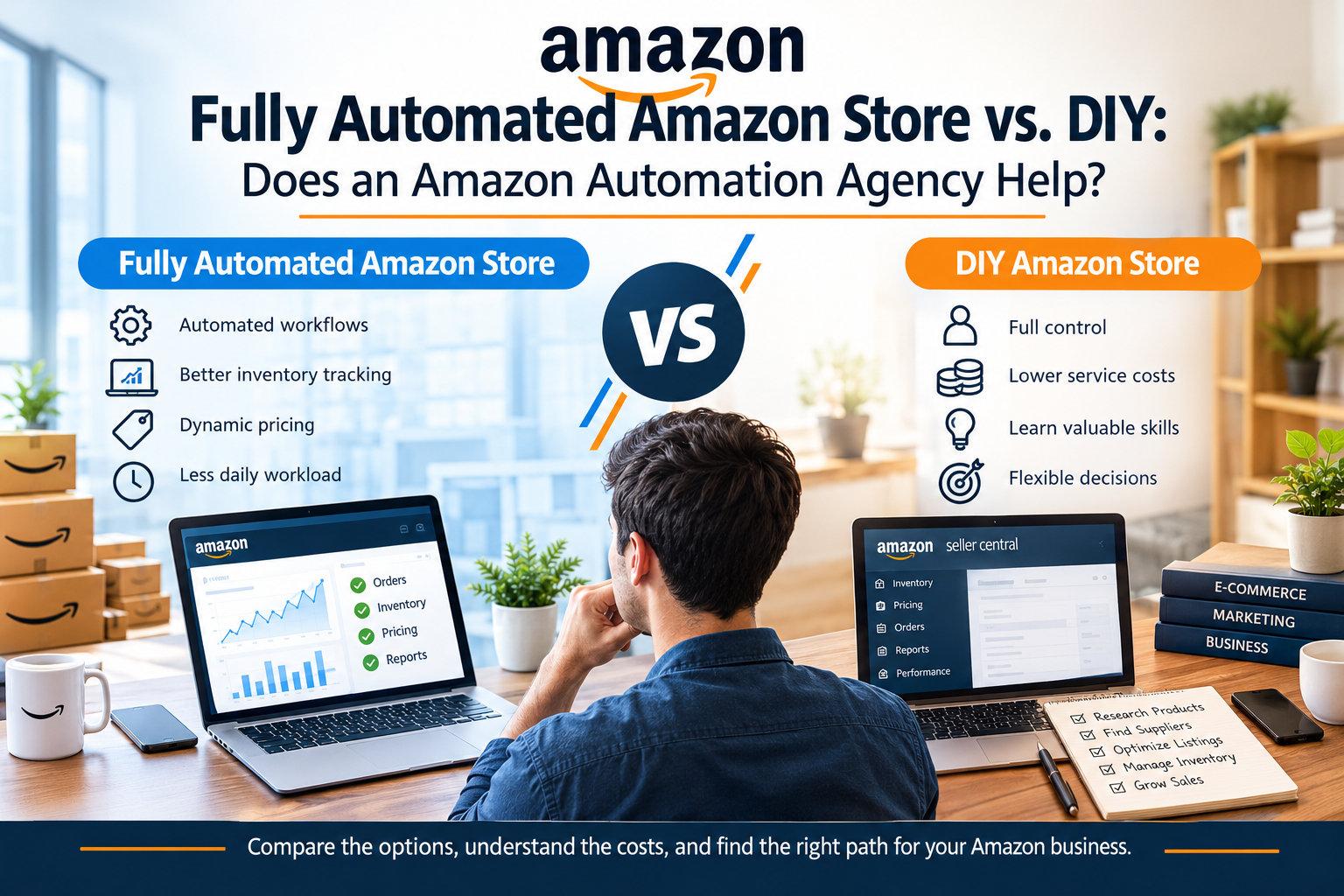
Running an Amazon business can look simple from the outside. You choose products, create listings, and wait for customers to place orders. In reality, a successful store requires much more work. Sellers must research products, evaluate suppliers, monitor inventory, calculate fees, manage pricing, and follow Amazon's marketplace policies.
For people who want to start selling without handling every task themselves, a fully automated Amazon store may sound appealing. The idea is straightforward: use technology and professional support to reduce the daily workload. Another option is to build the business yourself and hire an Amazon automation agency to handle selected tasks.
But does hiring an agency really make running an Amazon store easier? And is outsourcing better than managing the business yourself?
The answer depends on your experience, available time, budget, and expectations. Automation can make certain processes faster and more consistent, but it cannot eliminate business risks or guarantee profits. Likewise, the do-it-yourself (DIY) approach requires more personal involvement, yet it gives you greater control over important decisions.
This guide compares both approaches, explains what an agency can realistically do, and helps you decide which option makes sense for your circumstances.
What Is a Fully Automated Amazon Store?
A fully automated Amazon store is a term commonly used to describe an Amazon business that relies on software, automated workflows, and sometimes outside service providers to handle many routine operations.
Depending on the setup, these operations may include:
-
Monitoring inventory levels and replenishment needs.
-
Tracking competitor prices and adjusting prices within defined limits.
-
Organizing sales reports and expense data.
-
Managing parts of the product listing workflow.
-
Sending alerts about stock levels or unusual activity.
-
Coordinating selected administrative tasks.
Some managed-store arrangements also include product research, supplier coordination, listing preparation, and ongoing account support.
However, the phrase fully automated can create unrealistic expectations. An Amazon store still needs informed decisions, financial oversight, and regular monitoring. Software cannot guarantee that a product will sell, that a supplier will deliver on time, or that the business will remain profitable.
For example, a repricing tool may lower a product's price to remain competitive. If the seller has not set an appropriate minimum price, that adjustment could reduce the profit margin. Automation works best when someone understands the business rules behind each action.
It is also important to distinguish a managed service from Amazon's own fulfillment options. Fulfillment by Amazon (FBA) allows Amazon to handle eligible order fulfillment activities, including storage, picking, packing, shipping, and customer service for FBA orders. It does not automatically manage every aspect of the seller's business.
A store can use FBA without being fully automated, and a seller can automate certain tasks without hiring a management company.
What Does an Amazon Automation Agency Do?
An Amazon automation agency is a third-party service provider that helps sellers manage specific parts of their marketplace business. The services vary between providers, so the name alone does not tell you what you will receive.
One agency may focus on product research and listing optimization. Another may help with inventory planning, reporting, or operational management. Some providers offer broader packages that combine several of these services.
A seller might hire an agency to research potential products, prepare listing content, and organize inventory reports while keeping control of purchasing decisions and finances.
Another seller might need help only with a repetitive task, such as monitoring prices across a large product catalog. In that situation, specialized software or a limited consulting engagement could be more suitable than a comprehensive management package.
The important question is not whether an agency offers automation. It is whether its services solve a real problem in your business at a reasonable cost.
Before signing an agreement, ask for a clear list of responsibilities, deliverables, fees, reporting arrangements, and account-access requirements. You should understand what the agency handles and what remains your responsibility.
Fully Automated Amazon Store vs. DIY: Key Differences
Both approaches can support an Amazon business, but they offer different levels of control, assistance, and personal involvement.
| Factor | Fully managed or automated approach | DIY Amazon store |
|---|---|---|
| Daily workload | May reduce tasks handled personally | You manage most tasks yourself |
| Initial costs | May include agency fees and software costs | Can start with basic tools and limited outside help |
| Control | Depends on the service agreement | You make the main business decisions |
| Learning | You may rely on outside expertise | You develop skills through direct experience |
| Flexibility | Some changes depend on the provider | You can change your process directly |
| Oversight | You must review the provider's work | You monitor your own work |
| Main challenge | Costs, transparency, and provider quality | Time, learning, and operational mistakes |
Neither approach is automatically better. A beginner with a limited budget may prefer to learn the basics independently. A busy business owner may value professional assistance with repetitive or specialized tasks.
The best choice depends on how much time you can invest, which skills you already have, and whether outsourcing creates enough value to justify its cost.
1. The Advantages of a DIY Amazon Store
Building an Amazon business yourself can be a useful way to understand how the marketplace works. Although the learning process takes time, it gives you direct experience with the decisions that affect your business.
You maintain greater control
With DIY selling, you decide which products to research, which suppliers to approach, how much inventory to purchase, and when to adjust your strategy.
This control matters when market conditions change. If a product's sales decline or a supplier raises prices, you can investigate the problem and decide how to respond without waiting for an outside provider.
You can manage your budget closely
DIY sellers can begin with spreadsheets, Amazon's built-in tools, and a small number of carefully selected software subscriptions.
You may avoid recurring agency fees, although you still need to account for inventory, marketplace fees, shipping, returns, and other operating expenses.
You also need to consider the value of your time. Saving money on management services may not be worthwhile if administrative tasks prevent you from focusing on more important business decisions.
You learn valuable skills
Managing a store yourself teaches you how to evaluate products, calculate margins, communicate with suppliers, and interpret sales data.
These skills become particularly useful when you need to make decisions that fall outside a software tool's capabilities.
For example, a report may identify a product with rising sales, but you still need to determine whether the trend is temporary, whether the supplier can meet demand, and whether the product remains profitable after all costs.
You can start small and adjust gradually
DIY selling lets you test your processes before committing to a large operation.
You might begin with a limited product range, review performance, and improve your sourcing and inventory procedures as you gain experience.
This gradual approach can help you discover which tasks actually need automation instead of paying for services you may not use.
2. The Advantages of a Fully Automated Amazon Store
A well-designed automated workflow can reduce repetitive work and make business operations more consistent. The biggest potential benefit is not the elimination of work; it is the ability to spend less time on routine activities.
It can reduce repetitive tasks
Consider a seller who manages 150 products. Checking prices, stock levels, and sales performance manually can consume a significant amount of time.
Appropriate software can monitor these products and flag changes that need attention. The seller can then focus on the exceptions rather than checking every product individually.
This approach becomes more useful as the product catalog grows.
It can improve inventory monitoring
Inventory problems can affect cash flow in two ways. Running out of stock can lead to missed sales, while purchasing too much inventory can tie up money and increase storage costs.
Inventory tools can provide alerts and estimates based on available data. Sellers can use these insights to plan replenishment and identify products that may need attention.
However, forecasts are not guarantees. A sudden drop in demand, supplier delay, or competitor price change can make an otherwise reasonable forecast inaccurate.
It can organize business information
Reporting tools can bring together sales figures, inventory data, and expense information. This makes it easier to compare products and spot changes in performance.
For example, a seller might discover that one product generates substantial revenue but leaves little profit after fees, shipping, returns, and product costs.
That insight can help the seller reconsider pricing, sourcing, or inventory decisions.
It can support consistent processes
When a business uses documented rules and reliable workflows, it becomes easier to complete routine tasks consistently.
For example, a seller can establish a process for reviewing new supplier offers, checking product costs, and approving inventory purchases. Software can support parts of that process while the seller retains responsibility for important decisions.
The result can be a more organized business, provided the workflows remain accurate and someone reviews their performance.
3. Does an Amazon Automation Agency Save Time?
An agency can save time when it takes responsibility for tasks that would otherwise require significant effort from you. However, the amount of time saved depends on the scope and quality of its services.
Suppose you spend 15 hours per week researching products, preparing reports, and monitoring inventory. An agency takes over some of those activities, reducing your workload by eight hours per week.
That could free up time for supplier negotiations, financial planning, or other priorities.
But the arrangement also requires time for communication, reviewing reports, approving decisions, and resolving problems. If the agency's work needs frequent corrections, the actual time saved may be much smaller than expected.
Before hiring an agency, ask yourself:
-
Which tasks take the most time each week?
-
Can those tasks be outsourced or automated reliably?
-
How much will the service cost?
-
What level of supervision will it require?
-
How will I measure whether it saves time?
A useful arrangement should have clear responsibilities and measurable outcomes. Do not assume that a service will save time simply because it describes itself as automated.
4. How Much Does an Automated Amazon Store Cost?
There is no universal price for setting up or managing an automated Amazon business. Costs depend on the products you sell, the amount of inventory you purchase, the tools you use, and whether you hire outside help.
Potential expenses include:
-
Amazon selling-plan and referral fees.
-
Product inventory and supplier payments.
-
Shipping, fulfillment, and storage.
-
Software subscriptions and integration costs.
-
Agency setup fees or recurring management charges.
-
Returns, damaged products, and other unexpected expenses.
A DIY seller may spend less on management services but more time handling daily tasks. A seller who hires an agency may reduce personal involvement while taking on additional service costs.
To compare the options fairly, estimate the total cost over at least several months rather than focusing only on the initial payment.
For example, imagine an agency charges $250 per month. Over 12 months, that adds up to $3,000, excluding any setup charges or other business expenses. You should compare that amount with the actual work the agency will perform and the value of the time it may save.
This is an illustrative calculation, not a typical agency price.
Also, separate service costs from the money required to operate the store. A management package does not necessarily include inventory purchases, Amazon fees, shipping, or advertising.
Review current marketplace charges using Amazon Seller Central and calculate expected expenses for the specific products and fulfillment method you plan to use.
5. The Risks of Hiring an Amazon Automation Agency
Professional assistance can be useful, but it introduces risks that sellers should evaluate before signing a contract.
Unclear service agreements
Some service descriptions use broad terms such as store management or full automation without explaining the work included.
Ask for a written list of deliverables, timelines, fees, and responsibilities. Clarify which decisions require your approval and what happens when the agency does not complete the agreed work.
Unrealistic profit promises
No agency can guarantee that an Amazon store will generate a specific profit. Sales depend on competition, product demand, pricing, fees, supplier reliability, and other factors.
Be cautious when a provider promises guaranteed returns, effortless income, or a completely hands-off business. Ask how it calculates projected results and whether its figures include all relevant expenses.
Limited account access
Your Amazon account and business records are important assets. Before granting access to an outside company, understand which permissions it needs and why.
Use appropriate account permissions rather than casually sharing login credentials. Keep access to your financial records, inventory information, and business reports.
Clarify how access will work if the agreement ends.
Poor supplier or inventory decisions
An agency might recommend products that appear promising but carry substantial inventory risk. If supplier information is incomplete or sales estimates are too optimistic, you could commit money to products that perform poorly.
Review significant purchasing decisions and confirm that supplier documentation supports the products being sold.
Dependence on one provider
If you outsource every important activity without understanding the process, you may struggle to manage the store if the agency relationship ends.
Ask for documentation of key workflows and ensure you can access relevant records. Even when you outsource daily tasks, maintain enough knowledge to understand the business and make informed decisions.
Amazon's selling policies and seller code of conduct are also worth reviewing. Outsourcing operations does not remove your responsibility to comply with marketplace requirements.
6. What Tasks Should You Automate First?
You do not need to automate everything at once. In many cases, the best starting point is a single repetitive task that consumes time but follows a clear process.
Here are some examples.
| Task | How automation can help | What still needs human oversight |
|---|---|---|
| Inventory monitoring | Sends low-stock alerts | Confirming demand and supplier availability |
| Price tracking | Monitors competitor prices | Protecting margins and choosing pricing rules |
| Sales reporting | Organizes performance data | Interpreting trends and calculating profitability |
| Product research | Helps filter potential products | Verifying demand, restrictions, and supplier reliability |
| Listing management | Supports routine listing workflows | Checking accuracy and policy compliance |
| Replenishment planning | Estimates future stock needs | Approving purchases and managing cash flow |
For example, if you frequently forget to check inventory levels, an alert system may solve that problem without requiring you to hire an agency.
If you struggle to interpret profitability data across a large product catalog, reporting software or a qualified specialist may be more useful.
The key is to identify the actual problem before choosing the solution.
7. How to Choose the Right Amazon Automation Agency
If you decide that outside support could help, evaluate providers carefully. A good fit should offer services that match your needs, explain its process clearly, and provide enough transparency for you to monitor your business.
Check the scope of work
Ask what the agency will handle and what it expects you to do. Does it provide product research, listing support, inventory management, or routine reporting? Does it make purchasing recommendations, or can it commit your money without approval?
Clear answers help you compare providers on more than price alone.
Ask how performance is measured
Request regular reports covering the activities the agency manages. Depending on the agreement, these might include completed tasks, inventory issues, listing performance, expenses, or other relevant indicators.
Make sure you can distinguish sales revenue from actual profit. High sales figures do not necessarily mean the business earns a healthy return.
Review the contract and exit terms
Check recurring charges, cancellation requirements, access permissions, and the handling of business records when the agreement ends.
You should understand what happens to your workflows, reports, and supplier information if you decide to manage the business yourself later.
Verify claims before investing
Ask for evidence of relevant experience, but do not rely solely on testimonials or screenshots. Look for clear explanations of the provider's methods, limitations, and responsibilities.
Take time to compare alternatives and seek independent advice if the agreement involves a substantial financial commitment.
8. Who Should Choose DIY, and Who Should Consider an Agency?
Your circumstances can help determine which approach makes more sense.
DIY may suit you if…
-
You have a limited starting budget.
-
You want to understand Amazon's operations firsthand.
-
You have time to learn product research and inventory management.
-
You prefer to make decisions directly.
An agency may suit you if…
-
You have a clear need for specialized assistance.
-
Your schedule limits the time available for daily tasks.
-
You can afford the service without putting inventory funding at risk.
-
You are comfortable reviewing reports and supervising outsourced work.
A hybrid approach may suit you if…
-
You want to retain control of major decisions.
-
You need help with only a few repetitive or technical tasks.
-
You want to test automation before committing to a long-term service.
-
You prefer to expand your use of tools gradually.
For many beginners, a hybrid approach offers a practical middle ground. You can learn the fundamentals, manage your finances, and make product decisions while using software or specialists for tasks that genuinely benefit from additional support.
9. A Simple Plan for Getting Started
If you are still deciding whether to build your store yourself or work with an agency, follow these steps.
-
Set your budget. Account for inventory, marketplace fees, fulfillment, software, and unexpected expenses.
-
Learn the fundamentals. Understand product selection, supplier verification, listing requirements, and profit calculations.
-
Identify your biggest challenge. Determine whether you need help with research, pricing, reporting, or another specific task.
-
Compare your options. Estimate the cost of managing the task yourself against software and agency alternatives.
-
Start small. Test a limited product range or a single automation workflow before expanding.
-
Monitor performance. Review expenses, sales, inventory, and the time required to manage the business.
-
Adjust based on evidence. Keep, change, or discontinue tools and services according to their actual value.
This approach reduces the temptation to spend heavily on automation before you understand what your business needs.
Frequently Asked Questions
Is a fully automated Amazon store really possible?
Some Amazon operations can be automated, including inventory alerts, reporting, and rule-based pricing. However, a business still requires human oversight, financial decisions, supplier checks, and responses to unexpected problems. Complete automation without responsibility or risk is not a realistic expectation.
Does an Amazon automation agency guarantee success?
No. An agency may provide useful expertise and operational support, but it cannot control every factor affecting sales or profitability. Evaluate its services, fees, reporting, and contract terms rather than relying on promises of guaranteed returns.
Is DIY Amazon selling better for beginners?
DIY selling can help beginners learn how the marketplace works while keeping management costs under control. However, it requires time and careful research. Beginners who lack time may benefit from outsourcing specific tasks, provided they understand the costs and retain oversight.
Can I automate an Amazon store without hiring an agency?
Yes. You can use appropriate software, Seller Central tools, spreadsheets, and selected professional services to manage particular tasks. You do not need to outsource the entire business to benefit from automation.
What should I check before hiring an Amazon automation agency?
Review its services, pricing, relevant experience, reporting practices, contract terms, account-access requirements, and cancellation policy. Ask how it measures performance and avoid providers that promise guaranteed profits or refuse to explain their processes.
How much money do I need to start an automated Amazon business?
There is no single amount that applies to every business. Your budget depends on the products you choose, inventory requirements, marketplace fees, fulfillment costs, software, and any professional service charges. Prepare a product-specific budget before committing funds.
Conclusion: Does an Amazon Automation Agency Help?
A fully automated Amazon store can reduce repetitive work, improve reporting, and make certain processes easier to manage. However, automation does not eliminate the need for good products, reliable suppliers, sound financial decisions, and consistent oversight.
DIY selling gives you greater direct control and helps you build valuable skills, but it requires time and a willingness to learn. Hiring an Amazon automation agency may save time and provide specialist support, but you must weigh those benefits against the fees, contract terms, and risks involved.
For many sellers, the most practical approach is to combine personal oversight with selective automation. Learn the business, keep control of your finances, and outsource tasks only when the expected benefits justify the cost.
Ultimately, the best Amazon business is not necessarily the one with the most automation. It is the one you understand, can afford to operate, and can manage responsibly as market conditions change.